Start here
Is the Jinyeon royal performance in Seoul worth it? A 4.9 from 106 reviews, read closely
An hour of Joseon court music in a hanok room: who it suits, what it cannot give you, and how to decide before you pick a date.
Reserve your place ↗Quick answer
Yes, if you wish to hear Korean traditional instruments from a few feet away and are happy with a short, small, seated hour. GetYourGuide shows 4.9 stars across 106 reviews for a performance in a hanok-style room that recreates a Joseon royal banquet, with musicians in court dress, an optional hanbok photo and a replica throne. It is not a palace tour, a dinner or a full concert hall programme, and the venue sits up a staircase with no lift. As a close-up introduction to Korean music, it earns a slot in a Seoul itinerary.
The performance at a glance
| Jinyeon royal performance | |
|---|---|
| The show | A performance in a hanok-style room that recreates a Joseon royal banquet, with traditional instruments from court music to folk |
| Length | About one hour, says the booking page |
| Extras | Guests may dress in hanbok, sit on a replica royal throne, then meet the musicians and take photos |
| Room | Reviewers describe a very small room, with space for about ten spectators |
| Access | One floor up, stairs only, so wheelchairs are ruled out |
| Rules | Phones on silent; parking is limited, so public transport is advised |
| Booking | Cancel free of charge, pay after reserving; each session's time is in the calendar |
| Guest score | 4.9 across 106 GetYourGuide reviews |
| Suits | Couples, families with older children and anyone curious about Korean music |
| Less suited to | Wheelchair users, or anyone after a long programme or a meal |
The verdict in one paragraph
A rating of 4.9 over 106 reviews is high and fairly well supported, though 106 is a modest number next to the thousands that a famous Seoul tour collects. What the score tells you is that people who sat in this room liked it. What it cannot tell you is whether you will, because the show is a particular kind of thing: short, close and quiet. Court music was designed for ceremony and banquets, not for the explosive release of a pop concert, and the first minutes can feel unfamiliar to a Western ear. If that sounds like a draw, book it. If you were hoping for acrobatics, a drum riot or a story with a plot, one of Seoul's non-verbal shows will suit you better.
What the booking page actually describes
Strip away the adjectives and the booking page gives you this: roughly an hour in a hanok-style room made to recall a royal banquet of the Joseon dynasty, with musicians playing traditional instruments across genres from court music to folk. Guests may put on hanbok, sit on a replica of the royal throne, and afterwards meet the musicians and take photographs. That is the whole promise. It does not list a set programme, name the pieces, or promise food or drink, and none is invented here. The hero photograph on this site, taken from the booking page, shows two musicians in blue court robes and black hats on the floor of a timber-and-paper room, one bowing a two-string fiddle and one with a zither across her lap.
Why a banquet is the frame
The word jinyeon in the title is a clue worth unpacking. In Joseon court language it meant a celebratory banquet. Kim Jong Su, a researcher at the Kyujanggak Institute for Korean Studies, writes in Korea Journal that these feasts marked auspicious occasions such as holidays and birthdays, and that Joseon had no theatres for purely artistic performance, so royal banquets were where music and dance had their stage. That is why a show about court music borrows a banquet's setting. You are not watching a reconstruction of one specific feast; you are sitting in the kind of room where such music was heard, and the booking page says as much by calling it a recreation of a banquet atmosphere.
The instruments you are likely to see
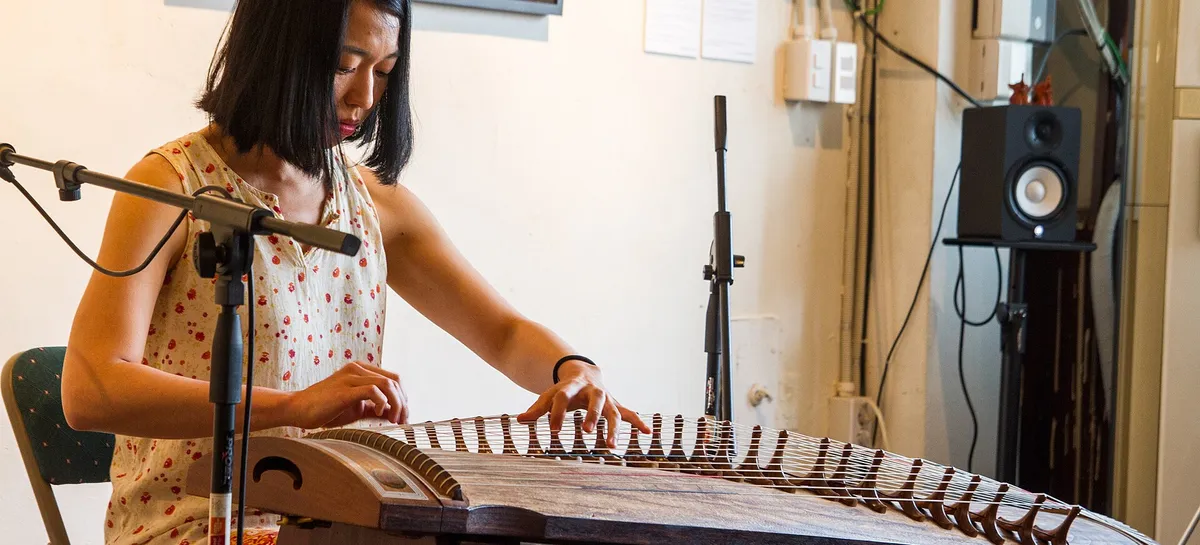
The booking page says only that traditional instruments are played, so the exact line-up depends on the session. Reviewers describe musicians who explain each instrument, which suits a first encounter. Two instruments are clearly visible in the booking photograph. One is the haegeum, a two-string upright fiddle held on the knee and played with a bow. The other is a plucked zither of the gayageum family, laid across the player's lap. Other court instruments you may meet are the daegeum, a large bamboo flute with a buzzing membrane, and the janggu, an hourglass drum. The companion guide on Korean court instruments explains what each sounds like and why it matters.
The hanbok and throne photographs
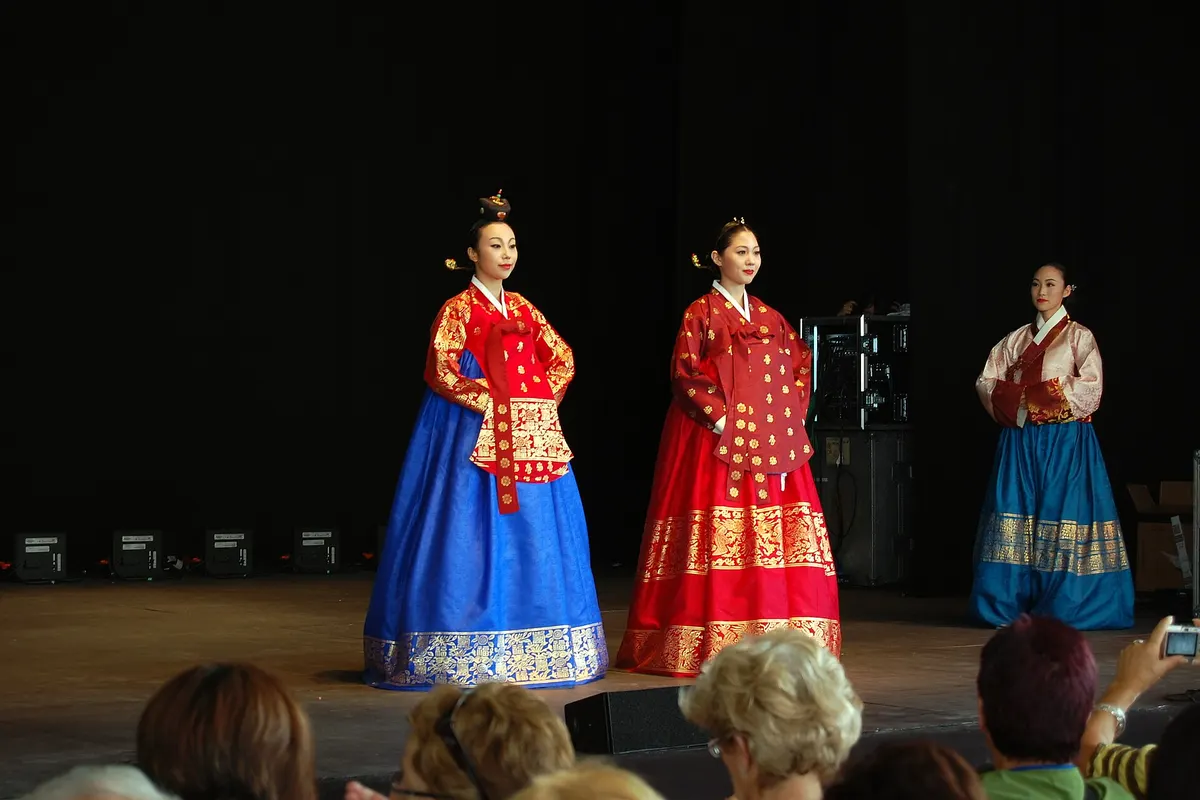
Dressing in hanbok and sitting on a replica throne is optional, according to the booking page, and it is the part most likely to divide opinion. For some guests it is the highlight, a rare chance to be photographed in Joseon dress with the musicians as the backdrop. For others it feels touristy. Both views are fair. The sensible approach is to decide in advance: if you would enjoy it, check the booking page and allow a few minutes for it; if you would not, you can simply sit and listen. Hanbok itself is far older than the Joseon period; Wikipedia traces its basic structure of top, trousers, skirt and coat to at least the Goguryeo era, and today's versions mostly follow Joseon court and noble dress.
Size, stairs and sound
Three practical facts shape the experience. First, the room is small: reviewers mention space for about ten spectators, which is why the hero line speaks of a few feet. That means the music is acoustic, close and unamplified in feel, and also that the session can sell out in a way a large hall cannot. Second, the venue is on the second floor, reached only by stairs; the booking page rules out wheelchairs. Third, phones must be on silent. Parking is limited, so the booking page advises public transport. None of this is a drawback if you know it in advance; it is the price of a performance this close.
What reviewers praise and where the praise stops
The positive reviews on GetYourGuide centre on the musicians' skill, the way each instrument is explained, and the sense of being invited into the music rather than watching it from a distance. The limits are the ones you would predict from the format: it is short, it is a performance for a handful of people, and it will not teach you the history of Korean music in depth. If you want that depth, the Jongmyo shrine and its ritual music, which UNESCO lists as intangible heritage, are the larger story behind what you will hear, and the guide on Jongmyo jeryeak covers them.
A fair way to read 4.9 out of 106
Ratings reward consistency, and a small room run by a small team is easy to keep consistent. With 106 reviews the average is meaningful but not bulletproof: a handful of lukewarm reviews would move it more than they would move a score built on thousands. Skim the latest reviews on GetYourGuide for the pattern, looking for comments about the musicians' explanations, the timing of the hour and how the room felt when full. Nothing on this page replaces those first-hand accounts; this guide only organises what the booking page itself states and what published sources say about the music.
Questions to ask yourself before booking
Do you want to hear instruments rather than watch spectacle? Can everyone in your group climb a flight of stairs? Are you comfortable sitting still and quiet for an hour in a small room? Do you want the optional hanbok photographs, or would you rather just listen? If the answers are yes, yes, yes and either, the performance is a good match. If any of the first three is a no, choose differently and do not feel bad about it; Seoul has a deep bench of evenings, and the sister guide to this one weighs one of the strongest alternatives.
When to choose something else
Choose otherwise if you use a wheelchair, if stairs are a problem, or if you need a full evening: this is about an hour. Pass if you dislike being asked to join in, since the throne photographs are part of the structure even when optional. And pass if you are certain you want a loud, theatrical Seoul show; there are several, and this is not one of them. The comparison guide weighs the performance against a four-hour night palace and market tour, which fills an evening in a completely different way.
How to book without regret
Open the calendar and select a session; each time is shown there, and the e-mail after booking repeats it. Cancelling is free of charge and payment comes after you reserve, so a plan that might change is not a risk. Arrive a little early, since a small room starts promptly,. If you travel with a group larger than the room can hold, reserve early and check which sessions still have room for everyone.
Frequently asked questions
Is the Jinyeon royal performance worth it?
Usually, if you like the idea of hearing traditional Korean music up close. Its 4.9 average over 106 reviews on GetYourGuide covers an hour in a small hanok-style room, with optional hanbok photos. Expect a short seated hour, not a big night out.
How long is it?
Roughly an hour, as the booking page puts it. The calendar gives each session's start, and the e-mail after booking repeats yours.
Is it suitable for wheelchairs?
No. The room is one floor up, and the booking page rules out wheelchairs because there is no lift.
Do I have to wear a hanbok?
No. The booking page says guests may dress in hanbok and sit on a replica throne; both are optional, and you can simply listen.
Sources