The instruments
Gayageum, haegeum, daegeum, janggu: the Korean court instruments you may hear
A plain-language guide to the zither, fiddle, flute and drum of traditional Korean music, with the facts that survive a fact-check.
Reserve your place ↗Quick answer
The gayageum is a plucked zither with traditionally twelve silk strings, the haegeum is a two-string upright fiddle played with a bow, the daegeum is a large bamboo transverse flute with a buzzing membrane, and the janggu is an hourglass-shaped drum with a different head at each end. The Seoul booking page does not list its instruments, but the hero photograph shows a haegeum and a zither of the gayageum family, and the other two are common in court and banquet ensembles.
Four instruments at a glance
| Instrument | Type | One fact |
|---|---|---|
| Gayageum | Plucked zither | Traditionally twelve strings; the legend credits King Gasil of Gaya in the sixth century |
| Haegeum | Two-string fiddle | Held vertically on the knee and played with a bow; made from eight materials |
| Daegeum | Bamboo flute | Has a buzzing membrane; other instruments tune to it |
| Janggu | Hourglass drum | Its two heads are said to represent yin and yang |
The gayageum: a zither from the Gaya confederacy
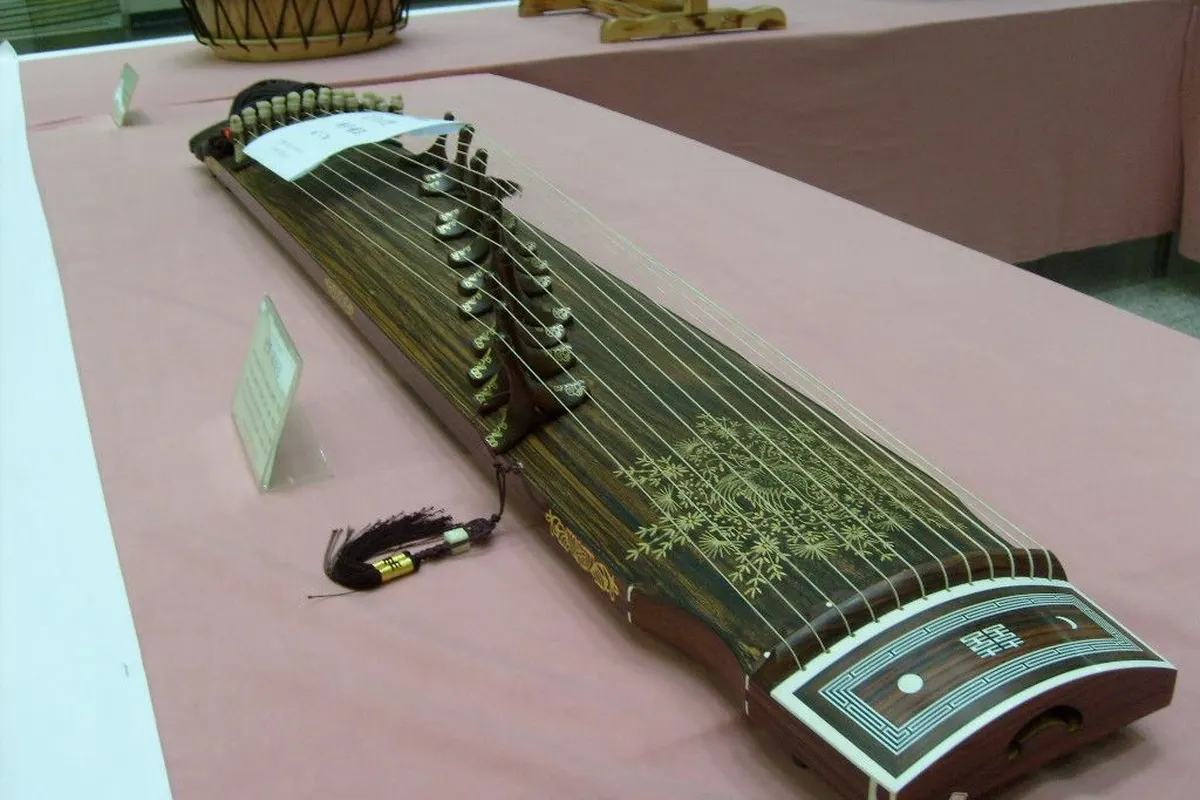
The gayageum is probably the best known traditional Korean instrument. Wikipedia describes it as a plucked zither, traditionally with twelve strings, with newer variants of eighteen, twenty-one or twenty-five. According to the Samguk sagi of 1146, it was developed around the sixth century in the Gaya confederacy by King Gasil, who ordered a musician, Wu Ruk, to compose for it, and the musician later refined it in the Silla kingdom. The old court form, called pungryu or jeongak gayageum, is larger, with wider string spacing for slow music; the smaller sanjo form, with closer strings, arrived in the nineteenth century for fast, improvised playing.
How it is played
Traditionally the player sits on the floor with crossed legs, the head of the instrument resting on the right knee and the tail on the floor, which matches the posture in the booking photograph. The right hand plucks and flicks the strings near the bridge, while the left hand presses the strings on the other side of the bridges to bend the pitch and add vibrato. Traditional strings are silk, and the body of the older form is paulownia wood, around 160 centimetres long. The sound is soft, delicate and subtle, which is exactly the kind of sound that a small room shows off well.
The haegeum: two strings, a world of expression
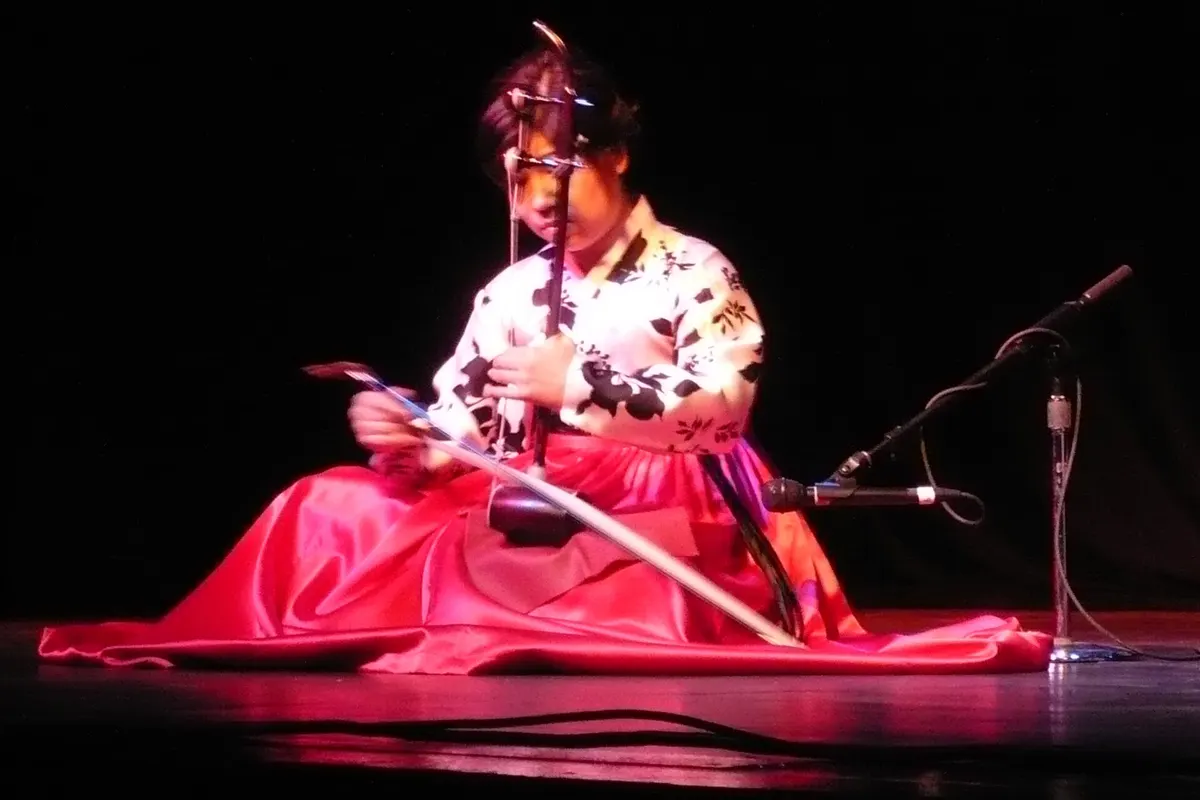
The haegeum is a vertical fiddle derived from the ancient Chinese xiqin, with a rod-like neck, a hollow wooden soundbox and two silk strings. It is held upright on the knee and played with a bow whose hair passes between the strings, so there is no fingerboard to press against. Wikipedia notes it is one of the most widely used instruments in Korean music, heard in court music and in the music of ordinary people, with a range from sorrowful to humorous. It is called paleum, eight sounds, because it is made from eight materials: metal, stone, silk, bamboo, gourd, clay, hide and wood. In the Joseon dynasty it was used in royal ancestral rites, parades, festivals and banquets.
The daegeum: the flute everyone tunes to
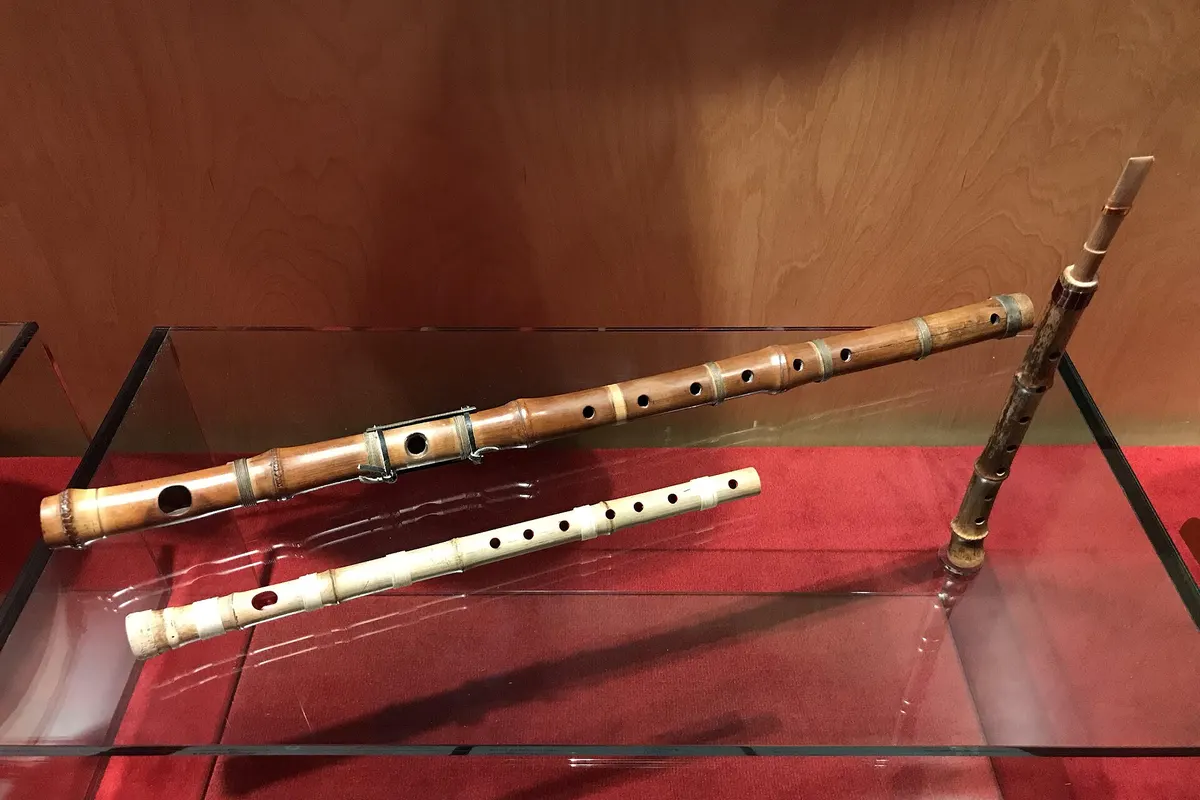
The daegeum is a large bamboo transverse flute with a buzzing acoustic membrane, used in court, aristocratic and folk music as well as contemporary classical and film scores. Wikipedia says its wide range and fixed pitch lead other instruments to tune to it. A longer jeongak form was the formal court version, and a shorter sanjo form is associated with commoners' music. Korean tradition ties its origin to a legendary bamboo flute, the manpasikjeok, said to have brought peace to Silla in the seventh century. The three bamboo flutes, daegeum, junggeum and sogeum, are known together as samjuk.
The janggu: a drum with two voices
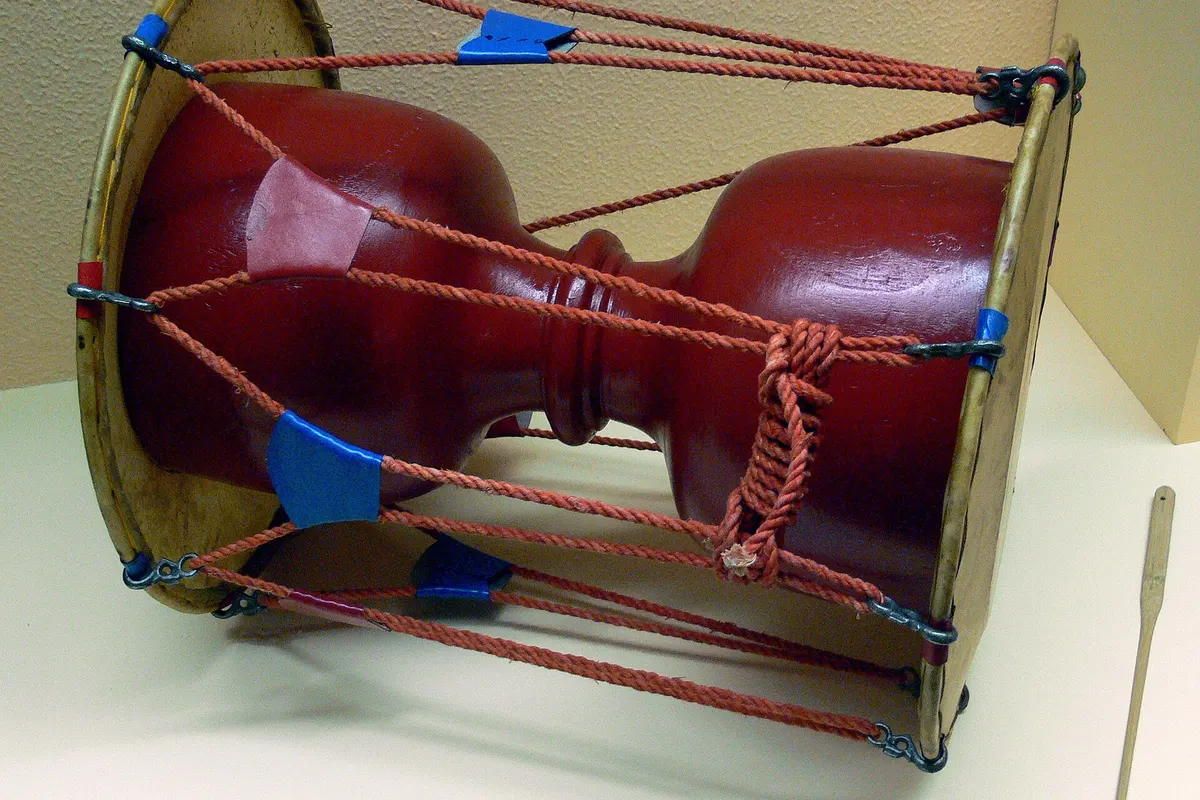
The janggu, or changgo, is an hourglass drum with two heads of different leather. The left head, covered with thick hide, gives deep low tones, and the right, with lighter hide, gives higher ones; played together they are said to represent the joining of yin and yang. The oldest depictions are on a Silla bell and in a Goguryeo tomb mural, and Goryeo records mention twenty janggu among gifts of instruments for a banquet in 1114. A mallet is used on one side and a thin bamboo stick on the other, a combination that lets one drummer make both rhythm and accent.
Listening tips
No theory is needed to enjoy the evening, but a few pointers help. Notice that the gayageum and haegeum are on the quiet side of the world's instruments and that the room does half the work. Notice how the bowed haegeum slides between notes where a Western violin would step. If a flute joins, listen for the buzz of its membrane, and if a drum comes in, hear how its two heads answer each other. Because the booking page names no programme, treat every instrument as a discovery, and ask the musicians afterwards; reviewers say they explain each one.
Frequently asked questions
Which instruments will I hear?
The booking page says traditional instruments are played, without a list. The booking photograph shows a haegeum and a zither of the gayageum family; the line-up may vary by session.
How many strings does a gayageum have?
Traditionally twelve. Modern variants with 18, 21 or 25 strings also exist, according to Wikipedia.
Is the haegeum a violin?
No. It is a two-string upright fiddle held on the knee, with the bow hair running between the strings, derived from the ancient Chinese xiqin.
Sources